I wonder how many audience members have made the same mistake as I did, assuming this was Ibuyambo Ensemble, not Orchestra. I’m glad of the happy accident.
The show Fragments of Sarah is an “interdisciplinary performance that reimagines the life and legacy of Sarah Baartman through sound, movement, memory and embodied storytelling”. Unsurprisingly, given the academic obfuscation in the description, nobody I speak to seems to know what to expect. Yet the Concert Hall, rather sadly attended to start with, keeps filling and filling long after the show starts.
One of my main gripes about the Baxter as a venue is the seats. About 3 years ago, they ‘renovated’ the concert hall and put new seats in so close together that it cripples everyone above 5’5”. But it does give one a conversational opening. I use this to full effect with my short neighbour, a first-year UCT Opera student (who “was one of those people who used to undermine music” apparently, but now is on board with whatever the university has to offer).
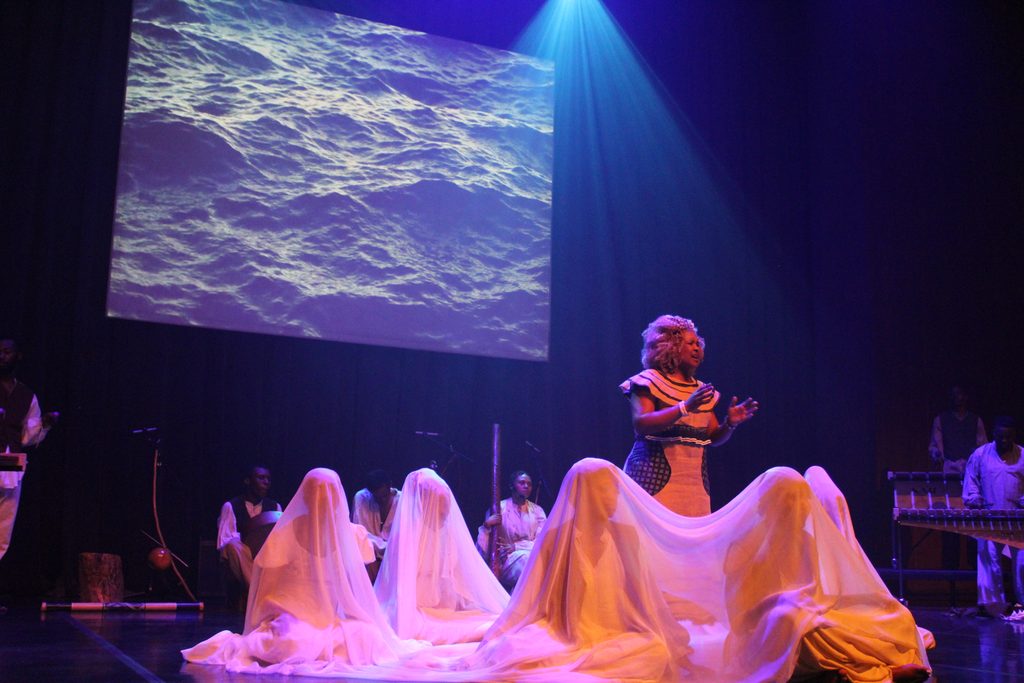
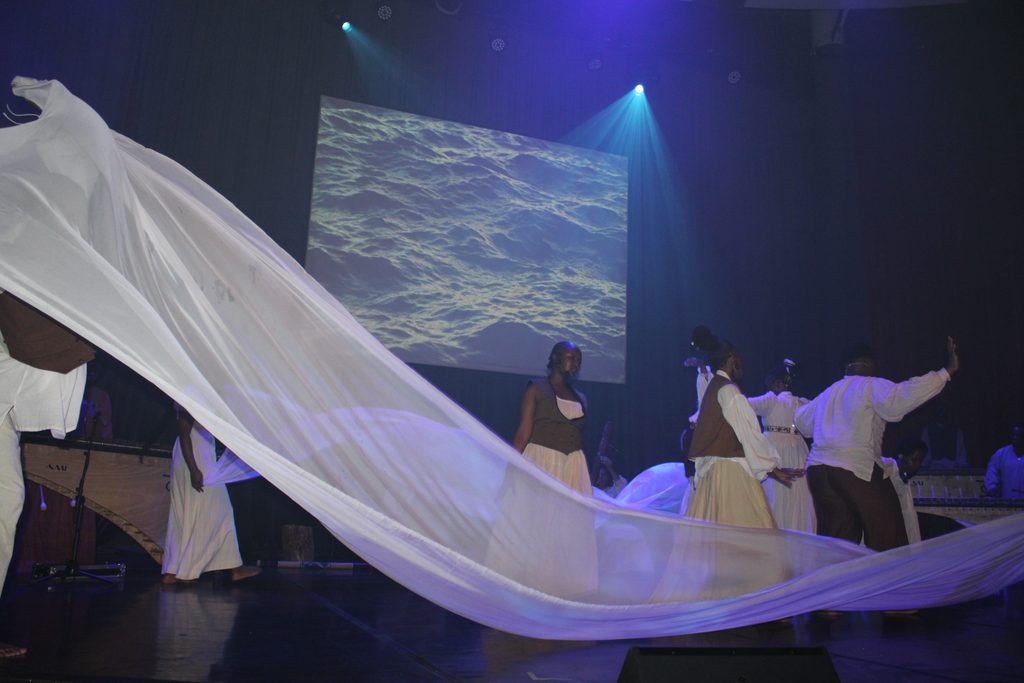
The performance is a series of sketches, roughly equal parts theatre, dance, and music, intertwined. Each scene is separated by a fade to black, and a new Roman-numeralled title projected on a screen above the stage. The near-constant choreography is impressive: lithe and alive. Loud prerecorded breaths begin our soundscape. The musicians on stage, also actors, are sometimes creating soundtrack ambience, and sometimes foley: great drums beating with every blow that our heroine withstands, uhadi creating the winds over the sea. Mbira for happier times, rainstick for transitions, what looks like a kora sometimes too. Many voices, then one.
The words are the part I find least compelling about the piece: both the titles projected on the screen, and some of the voiceovers. (The projector especially feels jarring: any reminder that we’re in a conference venue breaks the spell.) While the concluding question “What have we learned from my story?” is pertinent, it’s one that’s best left implied.
The imagery seems sacred. Ideas of reverence are always interesting to me. My accompanying photographer is warned off running up to the stage, because it would feel disrespectful to the sanctity of the moment. But when a woman behind me drops her phone, everyone scrabbles around under their seats to return it to her, using their own phone’s torches. This feels right.
There’s a series of stand-out moments in answer to the initial booming questions “Before the ships, who was she?” Girls sit in circles playing clapping games, singing and pounding grain. Black men in tailcoats arrive on stage and there are intakes of breath behind me, whispers of “1652”. Western clothes are donned, girlish postures slump. Sarah is kneeling, falling, running, falling again. There is a particularly disturbing part where Sarah is pulled around by a red rope of cloth, now around her waist, her head, her throat. All around me, women make sympathetic ‘mmm’ noises with each impact, as if they are watching their own daughter’s abuse. Throughout, the use of cloth is simple and stunning. Shaken chiffon under UV light is the sea, strips of white fabric are shackles, almost bandages. The woman playing Sarah seems to change: an effective device to show how many Sarahs there were, and are.
I remember my mother telling me about Sara Baartman, or Saartjie, as we learned of her. I expect this performance to relive her terrible exhibition, horror, humiliation. And it is a piece about trauma—it has to be—but it walks the line finely. Miraculously, the conclusion is thundering, building, bordering on joyous. A woman’s voice announces: “She is home!” and there is a cooing of “yhoooos” around me, hoots, clapping, whistles. Someone shouts “Halala!” again and again. There is, in some universe, in some moment, a return.
Photographs © Siyanda Mzantsi