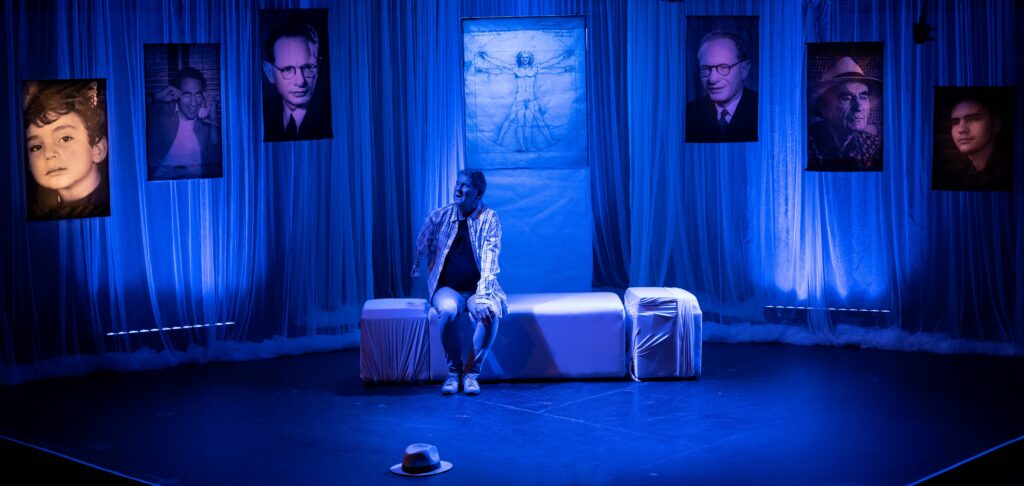
Graham Hopkins opens as Albie Sachs, dancing around the small stage merrily—but this is not to last. Within a few minutes, the tall box, one of a handful of vague props, becomes a stretcher, transporting Albie (as he’s referred to throughout) to hospital.
Portraits hang on either side of the stage, showing each of the three men at different ages. Later, a life-size image of the Vitruvian Man is revealed in the centre, but never directly addressed. The rest of the set, made of three moveable boxes, is one of the production’s strongest physical elements: pared down and impressive.
“Albie Sachs: Fathers, Sons and Soft Vengeance” is a rather cumbersome title for a play about lawyer–activist Albie Sachs and the famous car-bomb blast in 1988 that blew off his arm and blinded him in one eye. That story is well known; his relationships with his father, Solly, and his youngest son, Oliver, who was born when Albie was in his 70s, are less so. The title’s focus on soft vengeance—the triumph of the ANC’s ideals—feels less important than the father-son relationship.
Quite literally, the most touching moments are those of touch. The strongest scenes focus on bodily experience—not just the violent kind: sex, kissing, shivering, nuzzling, rawness, comfort and fear. One of the more moving lines comes early on, when Albie says: “I could never get too much affection.” There is a real and convincing attention to aliveness.
The play’s solution to acting without an arm—having Hopkins don a black glove—is simple and effective. Hopkins has clearly studied Albie’s mannerisms carefully and does an admirable job of embodying them. The theme of able-ness runs throughout: the pressure to wear a prosthesis to make other people more comfortable.
Much of the story is life-affirming: from Albie’s son Oliver taking mushrooms and recovering from depression to Albie requesting “the most vivid shirt you can buy in London” during his recovery. His line, “I don’t want to sneak back into the world,” is a good reminder to live boldly and freely while we can.
Interconnectedness is an important theme, but feels more like a buzzword than a genuine thread. Albie’s angst about a bystander being killed in the crossfire is performed loudly. Writing sensitively about events like these is difficult, particularly without direct experience of anything similar. But the scene feels like one more chance to add to the Albie mythos and self-aggrandise in the process, and verges on distasteful. This seems to be a problem of writing rather than of Albie’s own feelings. It also raises questions about how the play came about. Was it commissioned by Albie, now in his 90s, or by his family? What prompted the writer to create this show now?
A particularly funny and painful scene involves a recovering Albie trying to get out of the bath. The indignity of this “ludicrous exit” and the young nurse’s embarrassment at his nude struggles (ending with a “Gosh”) are funny and deeply uncomfortable. The audience can’t turn away.
But there is, quite conspicuously, only one body on stage. Hopkins does an excellent job of playing all the different characters: his movements and voice adapt masterfully to suit each role, and he is clearly skilfully directed. Albie’s son, Oliver, is represented by a disembodied voiceover. This raises questions about budget. Putting on productions here, now, is a costly business. Was a one-man play a practical consideration? One of theatre’s beauties is its ability to bring the dead back to life, and to have sons appear as children, then as grown men. This production doesn’t take up that opportunity. In the rather damning words of a fellow theatre-goer: “That black glove had more stage presence than the son.”
The audience is meant to leave with a very positive impression of Albie as a man resolved, his affairs in order. Here is a man who has served his country, and the world at large, fought for justice, survived atrocity, and even made up with his troubled son. Comments from Albie like “I’m not there much to teach him things” are not dwelt on.
In a way, Albie seems to have done his son down again: the truly difficult parts of their story remain uninterrogated. After an unexpected interlude about Oliver’s transformational psychedelic experience with mushrooms, voice-over Oliver says, “I want to get very rich, very quickly, Albie.” There is a passing mention of Oedipus in relation to this, and that’s all. It’s a missed moment. Earlier, there is mention of Albie moving to Mozambique without his wife or children. The onus is put on her to decide whether to join him, as if his going is a foregone conclusion.
Hopkins as an orthopaedic surgeon gets a laugh by asking: “What do you need an arm for?” Audiences might ask themselves: “What do we need theatre for?” “Albie Sachs: Fathers, Sons and Soft Vengeance” at the Baxter is a feel-good show. Whether it should be, this is less clear. The small audience leaves smiling, singing “Senzeni Na?” softly, without really interrogating the question.
Photo © Fiona MacPherson
It Wasn’t Like That!
No level-headed debates are in progress… yet.